Where to Invest Near Jewar Airport: Sector-by-Sector Reality Check, Due Diligence & Exit Strategy — Part 2 of 2
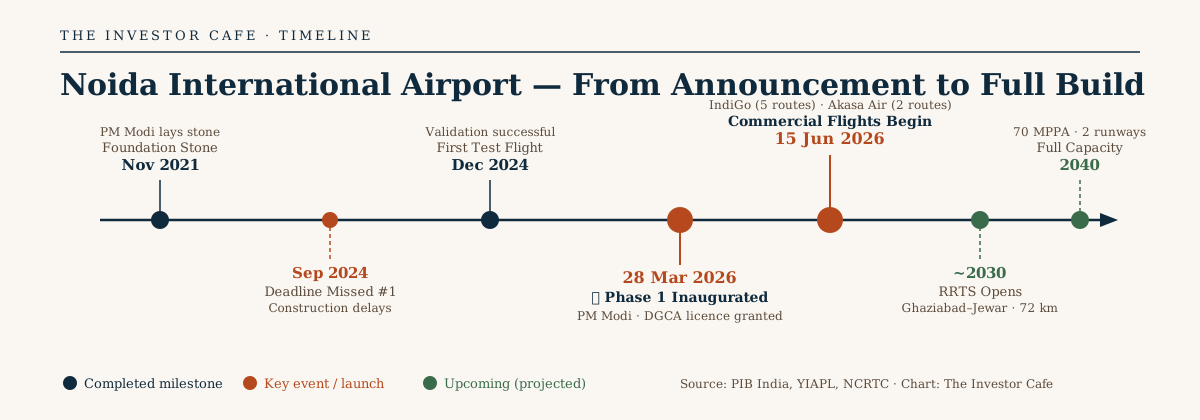
Flights have begun at Jewar. Now the real question: where exactly should you buy, what should you check before signing, and how do you eventually exit? This CA-led field guide covers sector-by-sector investment ratings, an 11-point due diligence checklist, the UP RERA verification walkthrough, stamp duty optimisation, and three exit paths every investor needs before committing capital.
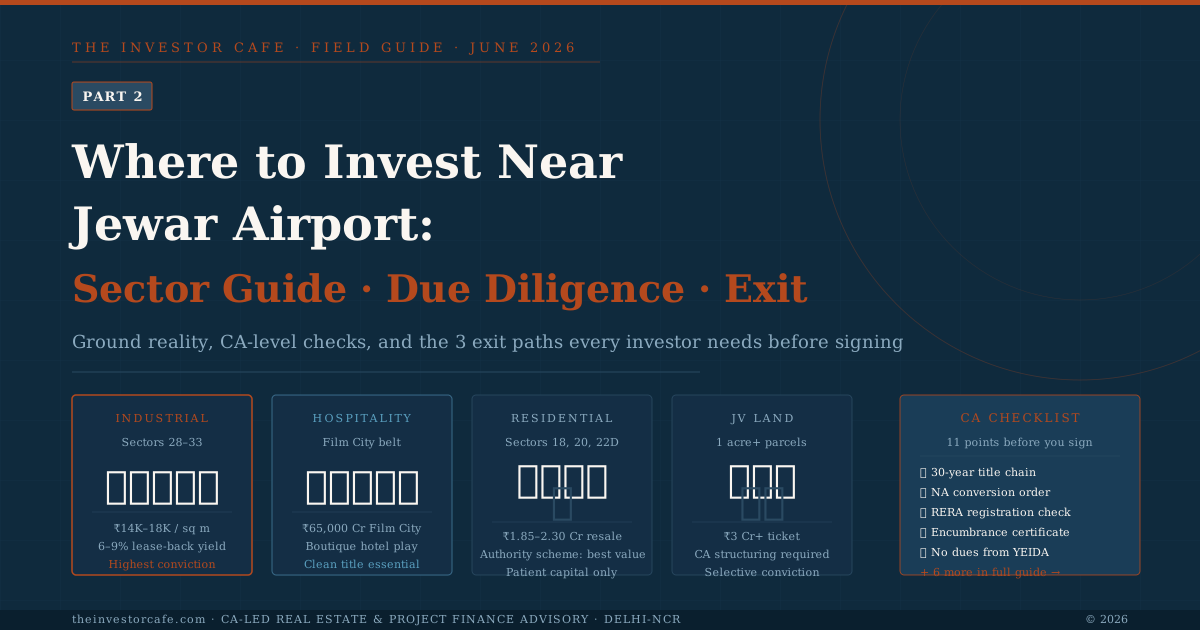
This is Part 2. Part 1 covered what actually opened at Jewar, the full infrastructure pipeline, how prices moved from ₹1,650 to ₹10,500 per sq ft between 2020 and 2025, and why the Gurgaon parallel only tells half the story. Read Part 1 here.
This part is the field guide: where specifically to look, what's genuinely on the ground today, how to verify a plot's legal status before paying a single rupee, and the three exit paths every investor should design before buying. Every observation comes from deals we've actually walked through — or walked away from.

1. Ground Reality First — What's Actually There in 2026
Before the sector guide, a CA-level honest assessment of the corridor that most broker pitches skip.
What's genuinely built and functioning:
The Yamuna Expressway itself is excellent — 6-lane, well-maintained, consistently the fastest road from Delhi to Agra. The YEIDA authority layout and sector grid are real: roads exist, parcels are demarcated, and authority-allotted plots have possession given. Sectors 18 and 20 have the most visible on-ground development — internal 18-metre and 30-metre roads are laid, some residential construction is underway, and YEIDA's GIS portal shows actual plot boundaries. The industrial belt in Sectors 28, 29, 32 and 33 has live anchor tenants: Vivo Mobile India, Amber Enterprises, and Minda Corporation are operational. The Vivo plant alone employs thousands of people and has brought secondary logistics and vendor activity to the corridor.
What is still a field:
Most of the residential sectors between the expressway and the airport — particularly Sectors 15, 24, and parts of 16 — are agricultural land with YEIDA planning overlays. Roads are marked on maps but not always on the ground. Social infrastructure — schools, hospitals, daily-need markets — is almost entirely absent outside the stretch between Pari Chowk and Sector 22D. Rental demand for residential plots is negligible; anyone telling you this is an income-generating play right now is mistaken. This is an appreciation corridor, not a yield corridor — at least for the next 3–5 years on the residential side.
The single most important ground truth for buyers:
Resale plots in this corridor often trade at 2–3× authority circle rates. A 300 sq m YEIDA-allotted plot in Sectors 18 and 20 that was originally allotted at authority rates is currently changing hands in the resale market between ₹1.85 crore and ₹2.30 crore. Authority-direct plots — obtained through the YEIDA scheme lottery — remain meaningfully cheaper. This gap is real, and it is the first question we ask every seller when a deal arrives at The Investor Cafe.
2. Sector-by-Sector Investment Guide
Residential Sectors — 18, 20 and 22D
What's there: These three sectors form the primary residential cluster of YEIDA City — the authority's planned urban settlement located roughly 10–12 km from the airport and 6–8 km from the Film City site. The YEIDA Residential Plot Scheme 2026 offers plots in Sectors 16, 17, 18 and 20, priced from ₹24 lakh onwards depending on size and location. The authority offered authority-scheme plots at a reserve price between ₹32,375 and ₹35,612 per square metre in its 2024 scheme. The 2026 scheme is expected to come in at ₹35,000–45,000 per sq m.
Resale market reality: 300 sq m YEIDA plots in Sectors 18 and 20 are currently changing hands in the resale market between ₹1.85 crore and ₹2.30 crore depending on corner/park facing status and cheque amount.
Who should buy here: End-users planning to build in a 3–5 year horizon, or investors who can hold without expecting rental income. Connectivity to Pari Chowk metro (existing) and the proposed Aqua Line extension makes this a genuine future residential node once population density picks up.
Our investment rating: ⭐⭐⭐⭐ — Strong appreciation case, clear authority title, metro alignment running through. Risk: timeline on social infrastructure is uncertain.
Developments to track: Eldeco Sector 22D and Gaur Sector 22D are two named private developer projects entering this corridor with apartment blocks — a signal that institutional money has started pricing in residential demand.
Film City Catchment — Sector 21 and Adjacent

What's there: The Bayview Bhutani International Film City in Sector 21 is the most transformative single project after the airport itself. The first film production — Mom 2 — commenced at the site in March 2026. Phase 1 covers 230 acres. The full 1,000-acre project, at ₹65,000 crore total investment with a PPP government revenue-share structure, is the demand anchor that makes commercial and hospitality assets in this sub-corridor genuinely compelling.
The ground reality of Sector 21: The Film City itself is under active construction. The immediate catchment — plots and shops near the main gate and service-road clusters — is where we are seeing developer interest, but most plots here are private-market, not authority-allotted. Title due diligence is critical here. We have reviewed plots in this micro-market where the seller's chain goes back three transfers with no registered ATS — which is a hard walk-away regardless of price.
Who should buy here: Commercial shop investors (the Film City will need F&B, logistics, talent-accommodation), boutique hospitality operators, and JV land aggregators. For pure retail residential buyers, this sub-sector carries more title risk than Sectors 18–20.
Our investment rating: ⭐⭐⭐⭐⭐ for commercial and hospitality assets with clean title · ⭐⭐⭐ for private residential plots without thorough due diligence
The Investor Cafe angle: Hotel and boutique hospitality assets near Sector 21 are the single highest-conviction segment in our current deal book. A 1-acre NA-converted parcel close to the Film City main road, structured as a lease-and-develop deal, represents the kind of risk-adjusted opportunity we specifically source and vet. If this is your profile, speak to our team directly.
Industrial Sectors — 28, 29, 32 and 33
What's there: These four sectors form the backbone of the YEIDA industrial corridor and are the most development-mature part of the entire belt. Industrial plots in Sectors 28, 29, 32 and 33 are available in areas from 5,000 to 20,000 sq m. Anchor tenants are operational. The Sector 28 Data Centre Park — comprising five large plots — is live and tenanted. Industrial land rates have moved from ₹6,000–8,000 per sq m in 2020 to ₹14,000–18,000 per sq m near Sectors 32 and 33.
Who should buy here: Manufacturers, logistics operators, EV-supply-chain players, data centre developers, and investors financing industrial capex through lease structures. Minimum ticket size for a meaningful industrial parcel starts at ₹1 crore for sub-5,000 sqm parcels in Sectors 32–33, and rises significantly for Sector 28 data-centre-grade plots.
Real-world anchor benchmark: Vivo Mobile India's operational presence in the corridor has created a secondary vendor ecosystem — components, packaging, logistics, maintenance — that is generating genuine occupier demand in Sectors 29 and 32. This is not speculative; it is a live demand signal.
Our investment rating: ⭐⭐⭐⭐⭐ for authority-allotted industrial plots with NA conversion and clear title — the strongest risk-adjusted segment in the corridor for investors with ₹1 Cr+ ticket size.
A Real-World Investor Example (With the Caveats Attached)
Land that cost around ₹1,650 per sq ft in 2020 now averages close to ₹10,500 per sq ft. In simplified terms, a buyer who invested ₹18 lakh in 2020 holds notional value of ₹1 crore plus by 2025, assuming market demand and sector remained strong.
That sentence is true. Here is the part that usually gets left out:
The ₹18-lakh buyer in 2020 bought a YEIDA-allotted plot in a notified scheme — which means their title was clean, their payment went to the authority, and their plot number maps to a registered lease deed. A large number of "plot investors" who entered this corridor between 2022 and 2024 bought from private re-sellers, paid 2–3× scheme rates, and have papers that consist of an ATS plus an unregistered possession letter. That plot may have appreciated on paper but is not bankable — meaning no institutional buyer, no home loan possible, and no clean exit until title is regularised, which can take years.
At The Investor Cafe, this is the first filter in our intake process: title first, price second. Every time.
3. How to Verify UP RERA in 4 Steps (Do This Before Signing Anything)
Visit the official portal at www.up-rera.in. Scroll to the homepage and click on "Registered Projects" under the Search section. Enter details such as the project name, RERA registration number, or promoter name. Enter the captcha code and submit your search. Then click the eye icon or "View Details" to access the full project record.
Here is what you are looking for, and what to do with each piece:
Step 1 — Confirm the project is registered at all. Any plotted development, group housing, or commercial project covering more than 500 sq m or 8 units must be RERA-registered before it is launched or advertised. If a seller says "RERA applied for" or "RERA exempt" for a residential layout — that is a red flag, not an explanation.
Step 2 — Check the declared completion date. The promoter submits this at registration. If the declared date has passed and no completion certificate has been issued, you are buying into a delayed project with legal exposure. Check the Quarterly Progress Reports (QPRs) on the same portal — these tell you what the builder self-reported as construction progress each quarter.
Step 3 — Check the 70% escrow compliance note. Developers must deposit 70% of all payments received from buyers into a separate escrow account, usable only for construction and land costs of that specific project. UP RERA's project detail page shows whether the promoter has declared their escrow account. If the field is blank or shows "not applicable" for a residential project, escalate this before proceeding.
Step 4 — Verify the agent. Real estate agents must register on the UP RERA portal under "Agent Registration," providing personal details, Aadhaar, and PAN. The portal allows you to search by agent registration number. If your broker cannot provide a UP RERA registration number, they are operating outside the law — and your transaction has no RERA consumer protection. Every agent at The Investor Cafe is RERA-registered.
4. The 11-Point CA Due Diligence Checklist
This is the list we run before presenting any deal to a buyer. It applies equally to YEIDA authority plots, private builder projects, agricultural land, and JV parcels.
- Title chain — minimum 30 years. Every transfer in the ownership chain must be registered. Unregistered GPA (General Power of Attorney) transfers before 2011 are a particular risk in this corridor — Supreme Court struck them down, but many plots still change hands this way.
- YEIDA allotment letter or registered lease deed. For authority plots, the original allotment letter and a registered lease deed (not just a possession letter) must exist. If only a possession letter exists, the lease deed must be obtained before you pay.
- NA (Non-Agricultural) conversion order. Plots sold for residential or commercial use on land that was originally agricultural must carry an order under Section 80 of the UP Revenue Code converting it to NA. This is not automatic — it requires a specific application to the district administration. We have seen dozens of "ready to build" plots in this corridor where NA conversion was pending.
- Encumbrance check — IGRSUP. Run an encumbrance certificate on the plot number at igrsup.gov.in for the last 13 years. This shows every registered transaction, mortgage, and charge on the property. Any undisclosed mortgage is a liability that transfers with the plot.
- RERA registration check for builder projects. As detailed in Section 3 above. Non-negotiable.
- No dues certificate from YEIDA. For resale plots, the seller must obtain a "no dues" certificate from the authority confirming all instalments and charges have been paid. Unpaid authority dues transfer with the plot — they become your liability.
- Circle rate vs transaction price gap. If the transaction price is significantly below circle rate, the buyer may face a tax liability under Section 56(2)(x) of the Income Tax Act — the difference is treated as "income from other sources." We review this for every deal.
- Road access verification — 45 ft or 60 ft road frontage. Plots fronting roads narrower than 18 metres are not eligible for multi-storey construction under YEIDA building regulations. We physically verify road width on-site.
- Litigation search. District court and RERA both maintain searchable cause lists. We check both for the promoter name and the plot/survey number.
- Builder track record for projects. For under-construction developments, we review the developer's delivery record on previous projects in Greater Noida and Noida before advising any client to commit. Three delayed projects in a builder's portfolio is not bad luck; it is a pattern.
- Proposed development compatibility. For JV land and large parcels, we cross-reference the proposed land use against the YEIDA master plan zoning layer. A parcel zoned "green belt" that is being sold as "commercial development potential" is a land fraud waiting to happen.
5. Stamp Duty Optimisation — Legal Structures That Save ₹50,000 to ₹2 Lakh
Structure 1 — Female co-owner registration (all buyers) Register the property jointly with a female family member as the primary applicant. Stamp duty in UP drops from 7% (male buyer) to 6% (female buyer). On a ₹1-crore plot, this is a ₹1-lakh saving for a single line change on the application form. For plots valued up to ₹1 crore with a female buyer, the effective duty falls to 5% — saving ₹2 lakh versus a male sole buyer.
Structure 2 — Phased registration for large parcels For land parcels above ₹1 crore, consult your CA (or us) on whether a phased transaction structure — where possession and payment happen in tranches — changes the stamp duty base. This is jurisdiction-specific and must be structured carefully to remain within the law.
Structure 3 — Company vs individual registration for commercial and industrial Industrial and commercial plots registered in a private limited company's name enable GST input tax credit on construction costs, which is not available for individual buyers. For a ₹2-crore industrial plot with ₹1-crore construction costs, the ITC alone saves ₹18 lakh in tax outflow. This is a CA-level structuring decision and one of the specific value-adds we bring to every industrial deal.
Structure 4 — HUF registration for residential plots Buying through a Hindu Undivided Family (HUF) entity with a female karta provides stamp duty benefits in some UP sub-registrar offices. Eligibility varies; we review this case by case.
6. Three Exit Paths — Design Your Exit Before You Buy
Most investors in this corridor have no exit plan. They bought on appreciation sentiment and are now stuck between a resale market that quotes prices buyers won't pay and rental income that doesn't exist.
Here are the three viable exit structures, in order of liquidity:
Exit 1 — Resale to an end-user or developer (2–5 year horizon) The most liquid exit. As population density increases post-airport, end-user demand for residential plots within 10 km of the airport will start absorbing inventory. The trigger to watch: when RRTS construction begins visibly and metro work starts, end-user sentiment will shift and resale velocity will pick up. For residential plots in Sectors 18–20, we project this window opens meaningfully between 2027 and 2029.
Exit 2 — Lease-back to an industrial operator (3–7 year horizon) For industrial plot holders, leasing the developed plot to an established operator (manufacturing, warehousing, data-centre) generates rental yields of 6–9% per annum on capital deployed — significantly better than residential. YEIDA's industrial transfer policy allows transfer of the plot after 3 years of operation with authority approval. This is the exit structure we most frequently model for our industrial-plot clients at The Investor Cafe.
Exit 3 — JV development (4–8 year horizon) For larger parcels — particularly 1-acre+ plots in the Film City catchment and hospitality zones — a JV with a developer or operator converts a land asset into a revenue-generating project. Our CA background means we structure these with a proper revenue-share waterfall, exit-clause review, and bank-compatible documentation from day one. We have completed JV structures in this corridor with project sizes ranging from ₹8 crore to ₹140 crore.
The worst exit is no plan. Plots that sat unsold in Noida Expressway's Sector 150 between 2016 and 2022 were held by investors who bought at peak FOMO without a structured exit — and they watched six years of capital being locked in a depreciating asset. The Yamuna Expressway corridor is better-planned and better-anchored — but the lesson holds.
7. Which Segment We're Invested In — And Why
The Investor Cafe's current deal book along this corridor is weighted as follows:
Industrial plots (Sectors 28, 29, 32, 33) — highest conviction. Authority-backed, NA-converted, anchor-tenanted corridor. Yields exist today (6–9% on lease-back). Capital appreciation upside from circle rate catch-up and operational density growth. Ticket size ₹1 crore and above.
Boutique hospitality assets (Film City catchment, Sector 21 belt) — high conviction for the right buyer. The Film City will generate a hospitality demand wave — film crews, talent, corporate events, tourism overflow — that is underserved by existing inventory. A 1–2 acre NA-converted plot structured as a boutique hotel or resort, financed through our NBFC/AIF lending network, is one of the highest-IRR plays in this corridor if executed correctly.
JV land deals (large parcels, YEIDA belt) — selective conviction. We review 4–6 JV pitches per month on this corridor. We proceed with roughly one per quarter. The filter is simple: title must be clean, NA conversion must be complete, developer must have a track record, and exit clause must be enforceable.
Residential plots (Sectors 18, 20, 22D) — moderate conviction for patient capital. Good appreciation case, strong authority backing. But buying in the resale market at 2–3× scheme rates reduces the margin of safety significantly. We advise clients to apply directly to YEIDA schemes rather than pay resale premiums, and we assist with scheme applications and post-allotment structuring.
What we are not buying: Private residential apartments from unknown developers, "farmhouse" parcels without a clear conversion status, and any plot where the seller's "urgency" is the primary pitch.
Frequently Asked Questions
How do I check RERA registration of a plot in UP?
Go to up-rera.in → click "Registered Projects" → search by project name, RERA number, or promoter name → enter captcha → click View Details. Check the completion date, QPR updates, and escrow compliance. For plots (as opposed to apartments), ensure the layout plan itself is RERA-registered — individual plots within a RERA-registered layout are covered; standalone unregistered khasra plots are not.
What is the difference between YEIDA-allotted plots and private resale plots?
YEIDA-allotted plots are acquired directly through the authority's scheme via a transparent lottery, with pricing set at circle rates and title backed by a government lease deed. Private resale plots are second-or-third-hand transfers, typically priced 2–3× scheme rates. Both can be legitimate investments — but the title verification requirements and risk profile are very different.
Is agricultural land near Jewar a good investment?
Only if it has a clear NA conversion order. Agricultural land without NA conversion cannot be legally used for residential or commercial construction, cannot be mortgaged to most banks for development finance, and carries the risk of state land acquisition proceedings. We review NA conversion documents for every agricultural land deal before giving any client an opinion.
What is the minimum ticket size to invest in the Yamuna Expressway corridor?
YEIDA residential scheme plots start from ₹24 lakh for 120 sq m. Resale residential plots in Sectors 18–20 start at ₹80 lakh for smaller 100 sq m parcels. Meaningful industrial parcels start at ₹1 crore. JV deals and hospitality assets typically begin at ₹3–5 crore. Our project finance desk arranges funding from ₹2 crore upward.
How does The Investor Cafe charge for advisory?
We are a CA-led advisory, not a brokerage. Our fee model varies by engagement — transaction advisory, title verification, structured finance arrangement, or JV structuring. We do not earn undisclosed commissions from developers. Every fee is disclosed upfront and structured in the engagement letter before work begins.
About The Investor Cafe
**The Investor Cafe** is a CA-led real estate investment and project finance advisory based in Delhi-NCR. Backed by 30+ years of CA practice, we source and structure deals along the Yamuna Expressway corridor — industrial plots (₹1 Cr+), residential plots and flats, commercial shops and studios, farmhouses and agricultural land, JV and large land deals, and boutique hotel assets.
Every deal we present is title-verified, NA-conversion checked, and structured to hold up to CA-level scrutiny before it reaches you.
On the finance side, we arrange project loans (₹25–500 Cr) from banks, NBFCs, AIFs and foreign funds, plus working capital (₹2–25 Cr) — all CA-structured, audit-ready, and routed through our 18+ banking partners.
If you are looking at a specific plot, parcel, or project on the Yamuna Expressway corridor — send us the address, sector, and seller's document summary. We will run a first-pass title check and price-sanity review before you engage further. No pitch, no push.
📩 Email: info@theinvestorcafe.com
📱 WhatsApp: 9310080419
🌐 Web: theinvestorcafe.com
Sources
- YEIDA official portal — yamunaexpresswayauthority.com — residential and industrial plot schemes 2024–26
- InvestoXpert RealX Stats Report (March 2026) — price appreciation data
- Plotland Guide — sector-wise land price ranges and ROI projections
- Colliers India — Jewar township land price report
- UP RERA official portal — up-rera.in — project verification process
- PIB India — airport inauguration, YIAPL announcements
- 99acres YEIDA schemes tracker — scheme dates and rates
- YEIDA Industrial Plot Brochure (January 2026) — YEA/IND8000(2025-26) — Sectors 29, 32, 33
- SKJ Landbase research note — 973-plot scheme analysis
- PropCompany.in — Yamuna Expressway property price buyer guide
- Income Tax Act Section 56(2)(x) — stamp duty and under-valuation tax treatment
- UP Revenue Code Section 80 — NA conversion process
This article is for informational purposes only and does not constitute investment, tax or legal advice. Property markets carry risk; past appreciation does not guarantee future returns. Before making any investment decision, please consult The Investor Cafe team or your own CA and legal counsel. All figures are sourced from public reports and operator disclosures as of June 2026.
© 2026 The Investor Cafe. All rights reserved.