Leasehold vs Freehold: What You're Actually Buying When You Buy a Plot Near Jewar Airport
Almost every plot along the Yamuna Expressway is leasehold, not freehold — a 90-year lease from YEIDA, not outright land ownership. Here's what that means for resale costs, bank financing, and the freehold conversion debate — explained the CA-led way.
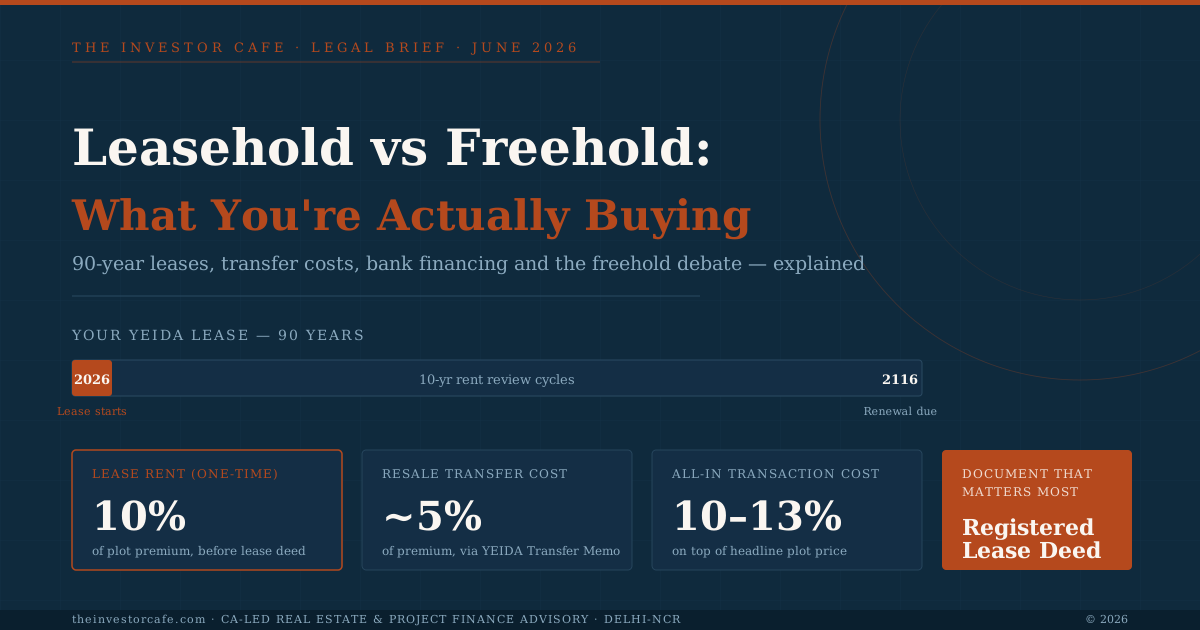
TL;DR — Almost every plot along the Yamuna Expressway corridor — every YEIDA sector, Noida, and Greater Noida — is leasehold, not freehold. You don't buy the land; you buy a 90-year lease on it from the authority. This matters for resale, bank financing, transfer costs, and what happens at the end of the lease term. This post breaks down exactly what leasehold means in practice, what it costs to transfer a leasehold plot, why banks treat it differently, and where the freehold conversion debate currently stands. If you've read Part 1 and Part 2 of our Jewar Airport series, this is the third piece of the puzzle — the legal nature of the asset itself.

Why This Matters More Than Most Buyers Realise
When we onboard a new client looking at a plot in this corridor, one of the first questions we ask is: "Do you understand that you are not buying the land?"
Most people pause at that question. They've seen "Plot for Sale" listings, they've seen prices per square metre, they've negotiated hard on the number — and somewhere in that process, the actual legal nature of what they're buying got lost.
Here's the plain fact: real estate in Noida, Greater Noida, and Yamuna Expressway is predominantly leasehold, where all plots and flats are sold on lease, typically for 99 years, but the respective authority retains ownership of the land. For YEIDA specifically — the authority governing the entire Jewar Airport corridor — the standard term is 90 years, calculated from the date of execution of the lease deed.
This isn't a defect or a red flag. It's simply the legal structure of how this entire region was planned and developed — and it has direct, practical consequences for what you can do with the asset, how banks treat it, and what your exit looks like.
1. What "Leasehold" Actually Means in Practice
In a freehold transaction, you own the land and whatever is built on it, indefinitely, and can sell, mortgage, modify, or pass it on without needing anyone's permission beyond standard local regulations.
In a leasehold transaction — which is what every YEIDA, Noida Authority, and Greater Noida Authority plot is — buyers own the building but lease the land, paying ground rent periodically to the authority. The lease deed is your title document. It is registered, it is legally enforceable, and it gives you genuine, transferable rights — but those rights come with conditions attached by the lessor (the authority).
Here's what that looks like for a typical YEIDA residential plot:
Element | What It Means |
|---|---|
Lease tenure | 90 years from the date of lease deed execution |
Lease rent | One-time payment of 10% of the plot premium before lease deed execution, in most current schemes |
Renewal mechanism | Authority typically renews on application; rent may be revised at each 10-year interval |
Construction obligation | Occupancy certificate must typically be obtained within 3 years of lease deed execution |
Transfer restriction | Authority NOC and Transfer Memorandum (TM) required before any resale |
For the current YEIDA RPS-10/2026 scheme — 973 plots across Sectors 15C, 18 and 24A — the structure is exactly this: a one-time lease rent of 10% of the plot cost is payable before signing the registry, and stamp duty (usually 5-7%) applies during registration of the plot.
The practical upshot: you have strong, government-backed, legally secure rights to build, live in, rent out, and eventually sell the property — but every transfer event requires the authority's involvement, and the clock on your ownership is ticking, even if 90 years feels distant today.
2. What Happens When the Lease Ends — And Why It Rarely Becomes a Real Problem
This is the question that worries first-time buyers the most, and it's worth addressing directly.
In theory, when a 90-year lease expires, if the lease is not renewed, the property reverts to the authority — though this is rare. In practice, authorities typically renew leases on application by paying renewal fees, and failure to renew resulting in reversion is an edge case, not the norm.
There's also a structural reason this is unlikely to be an issue for any plot bought today: a 90-year lease executed in 2026 doesn't expire until 2116. The renewal mechanics, fee structures, and even the authorities themselves will almost certainly look very different by then — likely converging toward some form of freehold or perpetual-renewal model, given the pressure described in the next section.
That said — lease balance matters enormously for resale and financing, even decades before expiry. A property with 90 years left is very different from one with 30 years remaining — when consulting real estate advisors, always ask specifically about the lease balance. A buyer purchasing a 25-year-old leasehold flat in central Noida today is in a meaningfully different position than someone buying a freshly-allotted YEIDA plot with a full 90-year term ahead of it. For Jewar-corridor buyers today, this is largely a non-issue — every plot allotted under current schemes starts its 90-year clock now.
3. The Real Cost of Transferring a Leasehold Plot
This is where leasehold ownership has an immediate, practical cost that freehold property doesn't — and it's a number every buyer and seller in this corridor needs to know before negotiating price.
When a YEIDA plot changes hands in the resale market, the process runs through four steps: first, the seller obtains a No-Due Certificate from YEIDA; second, the buyer and seller submit a transfer application and pay the applicable charges; third, YEIDA issues a Transfer Memo confirming the deal; and fourth, the buyer completes the registry and lease deed within 90 days.
The transfer charge itself is the cost most buyers don't budget for. Estimates for YEIDA resale transfers put this at roughly 5% of the current premium, in addition to stamp duty and registry fees. For comparable transfers in Noida and Greater Noida proper, Greater Noida group housing transfers are typically capped around 1%, while many Noida residential transfers are reported around 2.5% — though these figures vary by asset type, plot age, and current circulars, and should always be verified directly with the authority before finalising a deal.
Layer this on top of the stamp duty and registration costs we detailed in Part 1 (6-7% stamp duty, 1% registration, plus urban surcharge), and the all-in transaction cost on a leasehold resale plot can run 10-13% of the transaction value — a figure that materially changes the math on any "5x in 5 years" appreciation story. For a 162 sq m plot, the all-in cost including lease rent, stamp duty, and registration can realistically exceed ₹70-75 lakh before a single brick is laid — and that's before factoring in resale transfer charges on top.
This is precisely the kind of cost that gets glossed over in broker pitches and shows up as a surprise at the registrar's office. At The Investor Cafe, every price quote we give a client includes this full transaction-cost stack — not just the headline plot price.
4. One Important Cost-Saving Detail Most Buyers Miss
Within the leasehold structure, there's a meaningful choice that affects long-term cost: how you settle the lease rent.
Most current YEIDA schemes structure this as a 10% one-time lease rent payment before lease deed execution — which is the simplest and most common route. But older scheme structures (and some institutional/industrial categories) offer an alternative: paying the current year's lease rent multiplied by a fixed number of years — in YEIDA's case, 10 years — as a one-time payment equivalent to the lease rent for the entire 90-year duration.
Why this matters: once a 90-year lease deed is signed, the authority does not change the lease rent for that buyer for the remainder of the term — but a new buyer in a resale transaction has their lease rent recalculated based on the authority rate at the time of transfer, which could be significantly higher than what the original allottee was paying. Understanding which lease rent structure applies to a specific plot — and whether it's been settled as a one-time payment or remains an ongoing annual liability — is a detail that directly affects the true cost of ownership and should be confirmed from the lease deed itself, not assumed from the listing price.
5. Why Banks Treat Leasehold Differently — And What It Means for Your Financing
If you're planning to finance a plot purchase or a future construction loan against a leasehold plot, the lease structure directly affects your terms.
The core banking principle: financial institutions generally prefer freehold property — while loans for leasehold property are available, the loan-to-value ratio is often lower, because recovering money from a time-bound lease in case of default is harder than selling freehold land outright.
In practice, for YEIDA and Yamuna Expressway plots specifically, this plays out as:
- Banks do finance leasehold YEIDA plots — this is not a dealbreaker. Banks finance leasehold properties for home loans, provided the lease deed is registered, dues are clear, and there are no title violations.
- The remaining lease term affects eligibility. A fresh 90-year lease is straightforward; a much older leasehold asset with a shorter remaining term may face more scrutiny or reduced tenure on the loan itself.
- Registered lease deed is non-negotiable for financing. A plot still on "possession letter" status without a registered lease deed will face significant friction — most banks will not lend against it until the lease deed is executed and registered.
This is one reason our due diligence checklist in Part 2 placed such emphasis on confirming a registered lease deed, not just an allotment letter or possession letter. For any client planning to finance construction through one of our 18+ banking partners, this single document determines whether the financing conversation can even begin.
6. The Freehold Conversion Debate — Where It Actually Stands
This is the part of the leasehold story that generates the most noise — and the most confusion — so it's worth being precise about what is fact and what is aspiration.
The demand is real and long-standing. Residents' associations across Noida have demanded freehold status for residential properties for years, and the developer community has broadly supported conversion from leasehold to freehold as a positive step for all stakeholders.
The state government has, at points, proposed it — and the authorities have resisted. The Uttar Pradesh state government proposed allowing all seven industrial development authorities to allot land on a freehold basis, but the Noida, Greater Noida, and Yamuna Expressway authorities deferred this decision — on the grounds that lease rent is their major source of revenue for maintenance and development, and that freehold conversion would reduce their control over land use and planning.
Conversion is possible today, on a case-by-case basis, for a fee. The UP government does allow conversion of leasehold to freehold by paying conversion charges, with eligibility checked and applications made through the relevant authority — but this is an individual application process, not a blanket policy shift, and charges are calculated based on property value, type, and location, with final rates determined case by case.
The honest read for Yamuna Expressway / YEIDA specifically: we are not aware of any YEIDA-specific freehold conversion scheme currently in operation for the Jewar corridor sectors. The conversion conversation that exists in the public domain is primarily focused on older Noida and Greater Noida residential colonies, not the newer YEIDA allotments along the expressway. If and when a YEIDA-specific conversion policy emerges, it would represent a meaningful one-time value unlock for existing plot holders — but it should be treated as a possible future tailwind, not a factor to price into a purchase decision today.
7. What This Means for Your Investment Decision
Three takeaways to carry forward from this:
1. Leasehold is not a reason to avoid this corridor — but it is a reason to budget correctly.
The 90-year term is effectively a non-issue for any plot bought today. The real, immediate impact is the transaction cost stack — lease rent, stamp duty, registration, and (on resale) transfer charges — which can add 10-13% on top of the headline price. Price your deal on the all-in cost, not the per-square-metre rate quoted in a brochure.
2. Registered lease deed status is the single most important document for financing.
If you're planning to use bank or NBFC financing for construction, confirm the plot has a registered lease deed — not just an allotment or possession letter — before you commit. This is a binary gate for most lenders.
3. Don't price in freehold conversion as an assumption.
The conversion debate is real and ongoing, and could eventually unlock value for YEIDA plot holders. But it has no confirmed timeline for this corridor. Treat it as optionality you might benefit from someday — not as part of your base-case return calculation.
Frequently Asked Questions
Are YEIDA plots leasehold or freehold?
YEIDA plots — including all residential, industrial, and commercial sectors along the Yamuna Expressway — are leasehold, typically allotted on a 90-year lease from the date of lease deed execution. The authority retains underlying ownership of the land.
Can I get a bank loan for a leasehold plot near Jewar Airport?
Yes. Banks finance leasehold properties for home loans and construction finance, provided the lease deed is registered, all dues to the authority are clear, and there are no title violations. However, loan-to-value ratios may be somewhat lower than for equivalent freehold property, and the lease deed must be registered — not just a possession letter — for most lenders to proceed.
How much does it cost to transfer a leasehold plot in YEIDA?
Transfer costs for YEIDA resale plots are estimated at roughly 5% of the current premium, in addition to standard stamp duty (6-7%) and registration (1%). The process requires a No-Due Certificate from YEIDA, a Transfer Application, and a Transfer Memo, with the buyer completing registry within 90 days of the memo being issued.
Will YEIDA plots be converted to freehold?
There is no confirmed freehold conversion scheme specifically for YEIDA / Yamuna Expressway sectors at present. The UP state government has previously proposed freehold allotment across industrial development authorities, but Noida, Greater Noida, and Yamuna Expressway authorities deferred the decision, citing lease rent as a major revenue source. Conversion remains possible on a case-by-case application basis with conversion charges, primarily discussed in the context of older Noida residential colonies rather than newer YEIDA allotments.
What happens if I don't renew my lease after 90 years?
In theory, an unrenewed lease reverts the property to the authority. In practice, authorities typically renew leases on application and payment of a renewal fee, and reversion due to non-renewal is rare. For any plot purchased today, this is a non-issue for many decades — but always confirm the renewal mechanism stated in your specific lease deed.
About The Investor Cafe
**The Investor Cafe** is a CA-led real estate investment and project finance advisory based in Delhi-NCR. Backed by 30+ years of CA practice, we source and structure deals along the Yamuna Expressway corridor — industrial plots (₹1 Cr+), residential plots and flats, commercial shops and studios, farmhouses and agricultural land, JV and large land deals, and boutique hotel assets.
Every deal we present is title-verified, NA-conversion checked, and structured to hold up to CA-level scrutiny before it reaches you. That includes confirming lease deed registration status, transfer charge exposure, and lease rent settlement structure — the details in this article — for every plot we evaluate.
On the finance side, we arrange project loans (₹25–500 Cr) from banks, NBFCs, AIFs and foreign funds, plus working capital (₹2–25 Cr) — all CA-structured, audit-ready, and routed through our 18+ banking partners.
Considering a plot purchase and unsure about its lease status or transfer cost? Send us the allotment letter or lease deed — we'll review the lease structure and give you the real all-in cost before you negotiate.
📩 Email: info@theinvestorcafe.com
📱 WhatsApp: 9310080419
🌐 Web: theinvestorcafe.com
Sources
- Landeed — Leasehold Property in Noida and Greater Noida: Ownership, Title Transfer & Buying Guide
- 99acres — YEIDA Plot Schemes 2026: Important Dates, Key Insights and Latest Updates
- YEIDA Industrial Plots Brochure (January 2026) — yamunaexpresswayauthority.com
- Star Properties Delhi NCR — Leasehold vs Freehold in Noida & Greater Noida: Costs, TM Charges, Registry & RERA
- WhiteHat Realty — Is It the Safest Time to Invest in YEIDA Authority Plots
- HomesWala — YEIDA Plot Prices 2026: Latest Rates & Payment Plan
- EAuctionsIndia — YEIDA Plot Scheme 2026 (RPS-10) — true cost analysis
- GOV CSC — YEIDA Plot Scheme RPS-10/2026 guide
- Investors Clinic — Freehold vs Leasehold: Which Property Ownership Is Better
- 99acres — Should Land in Noida Be Converted to Freehold
- YEIDA Google Group archive — lease rent calculation methodology discussion
This article is for informational purposes only and does not constitute investment, tax or legal advice. Lease terms, transfer charges, and conversion policies are subject to change by the relevant authority and should be verified directly with YEIDA, Noida Authority, or Greater Noida Authority, and with your own CA and legal counsel, before making any decision. All figures are sourced from public reports and official brochures as of June 2026.
© 2026 The Investor Cafe. All rights reserved.