Industrial Plot vs Farmhouse Investment Near Yamuna Expressway: Which is Right for HNIs?
Two of the most-asked HNI questions on the Yamuna Expressway right now: industrial plot or farmhouse? They look similar on a map but are completely different assets — different legal structures, different tax treatment, different income potential, and different risk profiles. This CA-led comparison breaks down exactly what you're buying in each case before you sign anything.
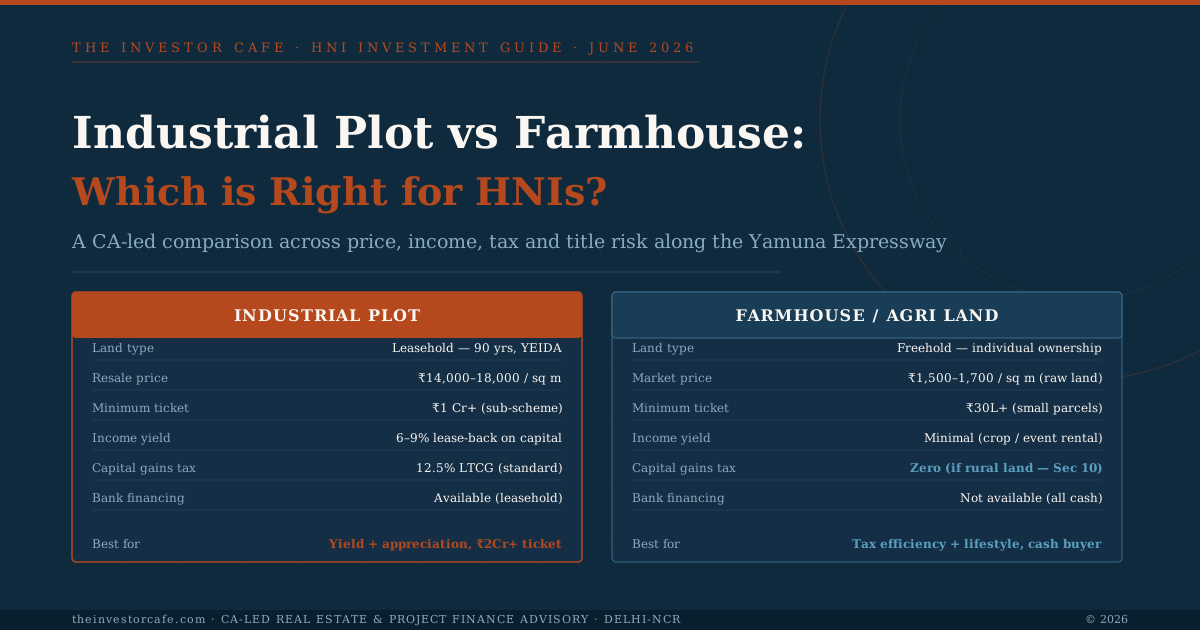
TL;DR — Two of the most searched real estate questions from HNI investors along the Yamuna Expressway right now: "Should I buy an industrial plot in Sectors 28–33?" and "Should I pick up agricultural farmland near the airport?" Both are genuine opportunities — but they are completely different assets, with different legal structures, different tax treatment, different income potential, and different risk profiles. This post gives you the CA-level comparison before you decide.

Why This Question Is Being Asked More Than Ever Right Now
Since Noida International Airport opened for commercial flights on 15 June 2026, something shifted in the conversation.
Interest in the Yamuna Expressway corridor moved from "early investor territory" to mainstream dinner-table discussion. And almost every second inquiry we receive at The Investor Cafe from an HNI in the ₹1 crore to ₹10 crore range is some version of the same question: industrial plot or farmhouse?
On the surface, both look like smart plays. Industrial land has authority-backed pricing, live anchor tenants, and a corridor being built specifically for manufacturing, logistics and data centres. Agricultural farmland trades at a fraction of those prices, carries significant tax advantages, and — let's be honest — there's a certain appeal to owning land near a major airport before the whole area gets too expensive.
The honest CA answer is that both can be the right call. But they're right for very different types of investors. Confusing the two, or buying one when you should be buying the other, is one of the most consistent mistakes we see in this corridor. This post is written specifically to eliminate that confusion.
1. What You're Actually Buying — The Legal Reality of Each
Most comparison pieces skip this part. We don't, because this is where the real differences live.

Industrial Plot
A YEIDA-allotted industrial plot is a 90-year leasehold asset from the authority, allocated through a transparent e-auction process. The lease deed is registered, the title is authority-backed, and the plot comes with a defined land-use classification — general industry, MSME, apparel park, toy park, data centre, or a similar category — with building regulations and FAR (Floor Area Ratio) clearly defined.
Industrial plots in the current YEIDA scheme cover Sectors 29, 32 and 33, with sizes ranging from 5,000 sq m to 17,020 sq m in the flagship scheme. Because these go through competitive e-auction, there is no fixed authority allotment price — the market sets the rate. In the secondary resale market, plots in these sectors are currently trading at ₹14,000 to ₹18,000 per sq m. Location charges of 5% per preferential factor apply — corner plot, green belt adjacency, 45-metre road frontage — up to a maximum 15% premium.
Farmhouse and Agricultural Land
Agricultural land along the Yamuna Expressway is freehold — unlike authority plots, you own the land outright, in your name, directly. It is typically traded in bighas or acres. In UP, an individual can purchase a maximum of 12.5 acres of agricultural land.
On pricing: raw agricultural land in the remote parts of the corridor — beyond 15 to 20 km from the airport — currently trades around ₹3,000 to ₹8,000 per sq m. Land closer to the airport catchment — within 10 km — has moved to ₹8,000 to ₹20,000 per sq m depending on how close it is to authority infrastructure. Private farmhouse projects with compound walls, internal roads and basic utilities are being offered at ₹20,000 to ₹25,000 per sq yard by developers like Da Foreste.
Here is the critical legal distinction that most investors miss, and that almost nobody puts upfront in their brochure:
Farmland in UP is classified as agricultural land with a specific land-use designation. You cannot legally build a house on it, run a business from it, or develop it commercially unless you obtain NA — Non-Agricultural — conversion from the district administration under Section 80 of the UP Revenue Code. The land is sold as agricultural land. Any construction on it without NA conversion is technically illegal and cannot be mortgaged to a bank.
This is not a technicality. It is the single most important fact about buying agricultural land near Jewar.
2. Price Comparison — What Each Costs Today
Parameter | Industrial Plot (YEIDA) | Agricultural / Farmhouse Land |
|---|---|---|
E-auction / authority rate | Set by competitive bidding | Not applicable (freehold market) |
Resale market rate | ₹14,000–18,000 / sq m | ₹3,000–8,000 / sq m (remote); ₹8,000–20,000 / sq m (airport catchment) |
Minimum ticket size | ₹1 Cr+ (sub-scheme) to ₹5 Cr+ (main scheme) | ₹30 lakh+ for small parcels; ₹1 Cr+ for meaningful size |
Private farmhouse project rate | Not applicable | ₹20,000–25,000 / sq yd (developed plots) |
Maximum UP purchase limit | No limit for industrial | 12.5 acres per individual |
Lease vs freehold | Leasehold (90 years) | Freehold |
One number deserves particular attention: even at the lower end of airport-catchment pricing, agricultural land still trades at a fraction of resale industrial plots. That gap — sometimes 3× to 5× — reflects the difference in legal certainty, permitted use, income potential and risk. It is not free money waiting to be captured. It is priced in for a reason.
3. Income Potential — Where Each Actually Generates Returns
Industrial Plot
An industrial plot generates returns two ways: capital appreciation as the corridor develops, and lease income if you develop the plot and lease it to an operator.
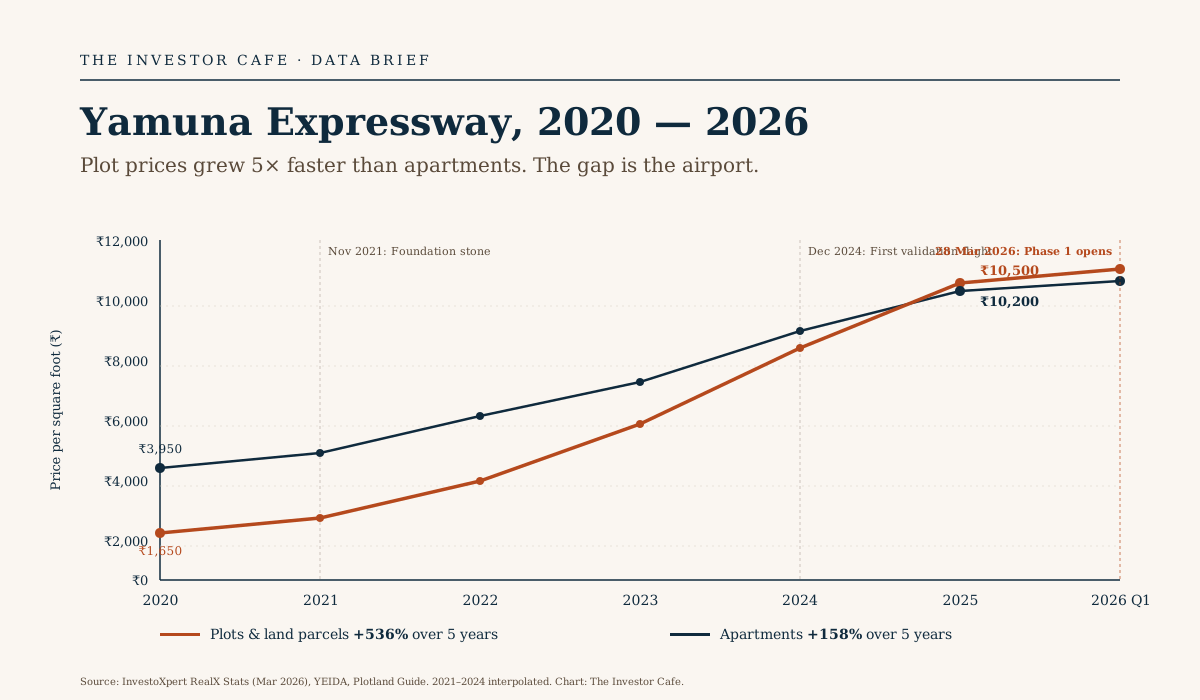
Capital appreciation has been real and meaningful. Industrial land in Sectors 32 and 33 moved from ₹6,000 to ₹8,000 per sq m in 2020 to ₹14,000 to ₹18,000 per sq m today — roughly a 100 to 125% gain over five years. That is slower than the headline residential plot appreciation (536%) but arguably more defensible, because it tracks actual occupier demand from manufacturers rather than speculative land premiums alone.
Lease income from a developed industrial plot — a warehouse, a light manufacturing unit, a logistics shed — generates 6 to 9% yield per annum on capital deployed. A ₹2-crore industrial plot with ₹1 crore in construction cost generating ₹24 to ₹27 lakh per year in lease income is a realistic mid-case scenario. YEIDA's industrial transfer policy allows resale after 3 years of confirmed operation, so the investor who builds and leases has a clear, defined exit path.
Agricultural and Farmhouse Land
Income from agricultural land on this corridor is genuinely limited at present, and it is worth being direct about that.
Crop income from farming is fully exempt from tax under Section 10(1) of the Income Tax Act. In practice, most HNI investors don't farm the land themselves — they either leave it, lease it to a tenant farmer for a nominal amount, or hire a caretaker.
Event and rental income from a developed farmhouse — banquet lawn, weekend gatherings, corporate events — can be meaningful, particularly for properties within 30 to 40 minutes of Noida and Delhi. But this requires NA conversion for the structures, appropriate municipal permissions, and actual investment in development. It doesn't happen automatically the moment you buy.
YEIDA acquisition compensation is something that circulates a lot in investor conversations. If your farmland sits in a notified acquisition zone, the compensation plus a 7% developed residential plot allocation (the "farmer quota") can be a significant event. But it is not predictable, not guaranteed, and the compensation rate is set by the authority — not the market.
Capital appreciation has been real. Agricultural land near Jewar moved from roughly ₹1,000 per sq m in 2018–2019 to ₹3,000–₹20,000 per sq m today depending on location. That's a genuine gain — but still below what authority-allotted plots returned in the same period.
4. The Tax Picture — Where Farmland Has a Genuine Advantage
This is the section most HNI investors get wrong. It's also where the CA lens matters most.
Industrial Plot Tax Treatment
An industrial plot is a capital asset. After 24 months, a sale qualifies as Long-Term Capital Gain (LTCG), taxed at 12.5% without indexation under Finance Act 2025. No special exemption applies unless proceeds are reinvested in another qualifying asset under Section 54F or 54EC. Lease income from a developed property is taxable as business income. If the plot is held through a company, GST on lease rent applies at 18%.
Agricultural Land Tax Treatment
Rural agricultural land — land beyond the specified distance from a municipal boundary — is not treated as a capital asset under the Income Tax Act. Its sale generates zero capital gains tax, regardless of the profit size. This is a statutory exemption, not a loophole.
Urban agricultural land, within or close to a municipal area, is taxable. LTCG applies at 12.5% without indexation. But even here, Section 54B of the Income Tax Act provides a full exemption if the sale proceeds are reinvested in another agricultural land within two years.
There is also no TDS obligation on agricultural land sales — Section 194-IA, which covers TDS on property, does not apply to agricultural land transactions regardless of how large the deal is.
Here is the CA-level structuring point that most investors genuinely don't know: For an HNI already in a high tax bracket, buying rural agricultural land near the corridor, holding it for 3 to 5 years, and selling — either to a developer or under YEIDA acquisition — can result in zero capital gains tax. This is legally correct, well-established, and not available in any other real estate asset class.
But — and this is important — it only works if the land genuinely qualifies as rural agricultural land. Urban agricultural land near Greater Noida municipal limits is taxable. The rural classification must be verified for your specific parcel before you assume this advantage applies to you.
5. The Risks Nobody Puts in the Brochure
Risks on the Industrial Plot Side
3-year transfer lock. YEIDA industrial plots cannot be transferred for the first three years from possession. If you need liquidity within that window for any reason, you simply cannot exit. This is not negotiable.
Operator risk on lease-back. A developed industrial plot generating 8% yield depends on a tenant operating and paying rent reliably. If the operator exits, you're carrying a vacant industrial shell with maintenance costs and no income until a new tenant is found. This risk is real, particularly in a corridor still building its occupier base.
Large minimum ticket. Meaningful industrial parcels start at 5,000 sq m. At ₹14,000 to ₹18,000 per sq m in the resale market, a single parcel costs ₹7 to ₹9 crore before a single rupee of construction. That concentrates significant capital in one asset.
Risks on the Farmhouse and Agricultural Land Side
NA conversion is not guaranteed. This is the single biggest risk, and it deserves more than one line. Agricultural land cannot legally be used for residential or commercial construction without NA conversion under Section 80 of the UP Revenue Code. The application process goes through the district administration. Approvals are neither fast nor guaranteed. Sellers routinely present "ready for conversion" or "NA applied" plots as if conversion is a formality. It is not. We have reviewed agricultural land parcels on this corridor where NA applications had been pending for over three years with no resolution. Buying on the promise of future NA conversion is speculation, not investment.
Bank financing is almost impossible. Most banks will not lend against agricultural land for purchase or development. Farmhouse investment is almost always an all-cash transaction. This means no institutional check on the price, no external legal vetting by a bank's panel lawyer, and full risk sitting with the buyer.
Title complexity on agricultural land. Agricultural land in UP is sold based on khasra and khatauni records. Mutation (daakhil-khaharij) must be complete and current. Many transactions on this corridor involve land with incomplete mutation, absent heirs, or multiple co-owners — including non-consenting ones. A proper title review must cover the last 30 years of khatauni records, family tree verification, and a district court search. Skipping any of these is how people lose money.
YEIDA acquisition cuts both ways. If your parcel sits in a future acquisition zone, you may receive compensation. But compensation is set by the authority — not the market — and is typically below what you paid if you bought at peak. The windfall story that circulates in investor circles is partially true, but the selection risk is high: only some parcels get acquired, and the timeline is impossible to predict.
6. The CA Verdict — Which Is Right for Which Investor
There is no universal right answer here. There is only the answer that fits your specific profile.
An industrial plot is the right choice if you have ₹2 crore or more available and can lock capital for five or more years. You want income-generating potential from the asset — lease income from a developed shed or warehouse. You want authority-backed, RERA-compliant, bankable title from day one. You're comfortable with leasehold structure. And you want exposure to the manufacturing and logistics boom along the corridor without the lifestyle overlay.
Agricultural or farmhouse land is the right choice if you're in a high income tax bracket and want a long-hold asset with genuine tax efficiency on exit. You have cash available — no bank financing is possible — and flexibility on timeline. You want lifestyle utility alongside the investment: a weekend retreat, green space, something to build over time. You're buying genuinely rural agricultural land (verify the classification, don't assume it). And you've done thorough title verification — khasra, khatauni, mutation, family tree, court search.
A third option most investors don't consider: both.
An HNI with ₹5 to ₹7 crore available can structure a combination — say, ₹3 to ₹4 crore in an industrial plot and ₹1 to ₹2 crore in farmland. The industrial plot gives yield, authority-backed appreciation and a clear exit. The farmland gives tax efficiency, lifestyle optionality, and a lower-entry position on the broader corridor. The two together also diversify across asset types, lender treatment, and exit routes.
This kind of portfolio structuring conversation is exactly what The Investor Cafe exists for. We don't push a product. We map your profile, your timeline, your tax position and your exit preference — and then present options that hold up to CA scrutiny before you sign anything.
Frequently Asked Questions
Can a non-farmer buy agricultural land near Yamuna Expressway in UP?
Yes. Unlike some states that restrict agricultural land purchases to farmers only, Uttar Pradesh allows any individual to purchase agricultural land, subject to the 12.5-acre maximum per individual. A company or partnership firm cannot directly purchase agricultural land in UP — it must be an individual or an HUF.
What is the maximum agricultural land one person can buy in UP?
An individual can purchase a maximum of 12.5 acres of agricultural land in Uttar Pradesh. For a larger holding, land must be purchased across multiple family members.
Can I build a farmhouse on agricultural land near Jewar Airport?
Not without NA (Non-Agricultural) conversion from the district administration under Section 80 of the UP Revenue Code. Construction on agricultural land without NA conversion is technically illegal and cannot be bank-financed. Always verify NA conversion status — or the exact stage of any pending application — before purchase.
What is the tax treatment on the sale of farmland near Jewar?
It depends on whether the land is classified as rural or urban agricultural land. Rural agricultural land is not a capital asset — its sale attracts zero capital gains tax. Urban agricultural land is taxable at LTCG of 12.5% without indexation under Finance Act 2025. Section 54B exemption is available if sale proceeds are reinvested in another agricultural land within two years.
Are YEIDA industrial plots transferable?
Yes, but only after 3 years of confirmed operation and with YEIDA's formal transfer approval. Industrial plots allotted through authority schemes carry a 3-year lock-in from the date of possession.
Which is better for HNI investors — industrial plot or farmhouse?
It depends on your ticket size, timeline, tax position and need for income. Industrial plots offer cleaner title, yield potential and authority backing — at a higher ticket. Farmland offers tax efficiency, freehold ownership and lifestyle utility — at a lower entry price but with more legal complexity. We review both for every HNI client before making any recommendation.
About The Investor Cafe

**The Investor Cafe** is a CA-led real estate investment and project finance advisory based in Delhi-NCR. Backed by 30+ years of CA practice, we source and structure deals along the Yamuna Expressway corridor — industrial plots (₹1 Cr+), farmhouses and agricultural land, residential plots and flats, commercial shops and studios, JV land deals, and boutique hotel assets.
Every deal we present is title-verified, NA-conversion checked, land-use confirmed, and structured to hold up to CA-level scrutiny before it reaches you. For agricultural land specifically, we review khasra records, khatauni, mutation status and the full family title chain before any recommendation.
On the finance side, we arrange project loans (₹25–500 Cr) from banks, NBFCs, AIFs and foreign funds, plus working capital (₹2–25 Cr) — all CA-structured and audit-ready.
Evaluating an industrial plot or farmland parcel on the Yamuna Expressway? Send us the khasra number or plot details — we'll run a first-pass title and classification check before you go further.
📩 Email: contact@theinvestorcafe.com
📱 WhatsApp: 9001995589
🌐 Web: theinvestorcafe.com
Sources
- YEIDA Official Portal — yamunaexpresswayauthority.com — industrial plot sectors, allotment rates, transfer policy
- YEIDA Industrial Plots Brochure YEA/IND8000(2025-26) — Sectors 29, 32, 33 — January 2026
- Plotland Guide — Yamuna Expressway property price trends and industrial land rates 2020–2025
- Velocity Housing / ERM Global Investors — agricultural and farmland market overview near Jewar
- 99acres — agricultural land and farmhouse listings, Yamuna Expressway corridor (June 2026)
- Da Foreste — private farmhouse project pricing on Yamuna Expressway
- Tax2win — Section 54B: Capital Gains Exemption on Sale of Agricultural Land (2026)
- Income Tax Department — Exemption to Capital Gains on Transfer of Agricultural Land (Section 54B guide)
- Upstox News — Selling agricultural land in 2026: capital gains tax rules
- ClearTax — Section 54B: Capital Gains on Sale of Agricultural Land
- UP Revenue Code Section 80 — Non-Agricultural (NA) Conversion Process
This article is for informational purposes only and does not constitute investment, tax or legal advice. Agricultural land classification (rural vs urban) and NA conversion eligibility must be verified for specific parcels and cannot be assumed from location alone. Consult The Investor Cafe team or your own CA and legal counsel before any investment decision. All prices are sourced from public listings and authority documents as of June 2026.
© 2026 The Investor Cafe. All rights reserved.