Project Loan Syndication: What Indian Developers Need Before Approaching a Bank
Getting a real estate project loan sanctioned in India is harder since October 2025 — the RBI's new Project Finance Directions changed the rules for every bank and NBFC simultaneously. This CA-led guide covers the full document stack, the three ratios that determine yes or no, the five most common rejection reasons, and how to match your project to the right lender type.
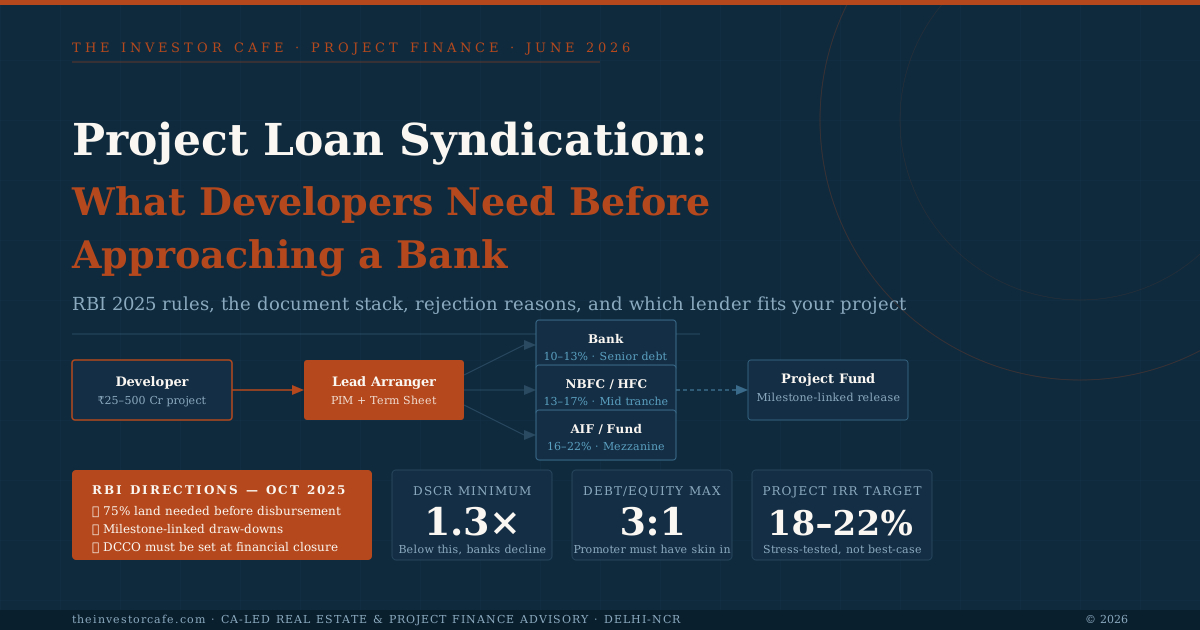
TL;DR — Getting a real estate project loan sanctioned in India — whether ₹25 crore or ₹500 crore — is harder than it was before October 2025. The RBI's Project Finance Directions 2025 (effective 1 October 2025) introduced stricter land availability requirements, milestone-linked disbursements, and tighter documentation standards across all banks, NBFCs and housing finance companies simultaneously. This post covers exactly what a bank's credit committee looks for before sanctioning a project loan, the document stack that wins approvals, the five most common reasons developers get rejected, and how to choose between banks, NBFCs and AIFs for your specific project profile. At The Investor Cafe, we arrange project finance from ₹25 crore to ₹500 crore across 18+ banking and NBFC partners. Every deal we present is CA-structured and audit-ready before it hits a banker's desk.

Why Most Project Loan Applications Fail Before They're Even Read
The number that nobody in the developer community talks about openly: in India, the rejection rate on first-submission project loan applications — across banks and NBFCs for real estate projects — is estimated above 60%. Not because the projects are bad. Because the applications are.
The single most consistent issue we see at The Investor Cafe when a developer approaches us after a bank rejection is this: the Detailed Project Report was either copy-pasted from a template, or was prepared by someone who optimised the numbers to look good rather than to be coherent. A bank's credit committee cross-references your DPR against your CMA data, your CIBIL, your GST returns, your bank statements, your land documents, and your RERA registration simultaneously. Any inconsistency between these documents creates an immediate trust deficit that is very hard to recover from in the same application cycle.
This guide is written for the developer, promoter, or landowning family who wants to understand what a bank actually looks for — before approaching a single lender.
1. What Project Loan Syndication Actually Means
A project loan syndication is a financing arrangement where multiple lenders — banks, NBFCs, AIFs — come together to collectively fund a single project, with each lender taking a defined share of the total exposure under a common loan agreement.
It is used when:
- The project size exceeds what a single lender can or will sanction alone (either due to exposure limits or risk appetite)
- The developer wants to access a mix of lending types — say, a senior debt tranche from a bank at lower cost, topped up with a mezzanine tranche from an AIF at higher cost but more flexible terms
- The developer's existing banking relationship does not have adequate sanction headroom
In a syndicated structure, one lender acts as the Lead Arranger — they appraise the project, prepare the Preliminary Information Memorandum (PIM), negotiate the term sheet with the borrower, and invite other lenders to participate. Once all lenders commit, an Intercreditor Agreement (ICA) governs how decisions are made, how security is shared, and what happens if the project faces stress.
The key legal documents in a syndicated real estate project loan include: a Loan Agreement defining terms, repayment, covenants and events of default; an Intercreditor Agreement governing rights among lenders; Security Agreements outlining collateral; an Agent Bank Agreement defining the lead bank's role; and a Common Mortgage Deed for shared security.
For developers seeking ₹25–500 crore — the range The Investor Cafe operates in — syndication is often the optimal structure. It gives you access to more capital than any single lender will deploy, while giving the lenders the comfort of shared risk and a documented intercreditor framework.
2. What Changed After October 2025 — The RBI Project Finance Directions
This is the piece of the puzzle that every developer approaching a bank in 2026 must understand — and that most advisory firms have not yet fully internalised.
The RBI (Project Finance) Directions, 2025, issued vide circular RBI/2025-26/59 on 19 June 2025 and effective from 1 October 2025, establish a standardised framework applicable simultaneously to all commercial banks, NBFCs (including housing finance companies), primary cooperative banks and all-India financial institutions. Before this, different lenders operated under different frameworks for project loans. From October 2025, they all work from the same rulebook.
The changes that directly impact real estate developers:
Land availability before first disbursement. As a pre-requisite for loan disbursement, the lender must ensure the borrower has land availability of at least 75% for all non-PPP projects — which includes commercial real estate (CRE) and CRE-residential housing (CRE-RH). In practice, this means a bank will not release even the first tranche of a project loan unless you can demonstrate clear title and possession over 75% of the total project land. Developers who structured their land acquisition in phases — buying remaining parcels from project cash flows — must rethink that sequence entirely.
Milestone-linked disbursement. Disbursements must be proportionate to project completion stages and equity infusion, and must be certified by an Independent Engineer or Architect at each stage. You cannot draw down the full sanctioned amount at financial closure — each tranche release is linked to a construction milestone verified by a third-party engineer.
DCCO must be documented clearly. The Date of Commencement of Commercial Operations — the date by which the project is expected to generate revenue — must be defined at financial closure. DCCO extensions of up to 2 years are permitted for non-infrastructure projects (including real estate) without the loan being classified as NPA, provided cost overrun is within 10% of the original project cost and financial covenants remain unchanged.
CRE provisioning at 1.25%. During the construction phase, the standard asset provisioning requirement is 1% for most project categories, but 1.25% for under-construction commercial real estate exposures. This means banks carry a slightly higher capital charge for real estate project loans than for industrial or infrastructure lending — which subtly affects pricing and appetite.
The practical implication for developers: if your project was structured or appraised before October 2025, your banker's internal approval process has likely been updated to comply with these Directions. Any documentation package that predates these changes needs to be reviewed and updated before resubmission.
3. The Document Stack — What a Bank Needs Before It Opens Your File
The following is the minimum documentation stack that a bank's credit team will need before beginning formal appraisal. Missing any of these at first submission is a near-certain delay of 4–8 weeks while the bank waits for you to compile.
Project documents:
- Detailed Project Report (DPR) — customised, project-specific. Not a template. Banks can immediately identify generic copy-paste project reports because the financial figures and operational details do not match the practical ground reality of the specific project. A generic DPR reduces the credibility of the borrower and creates an impression that proper feasibility analysis has not been conducted.
- RERA registration certificate — mandatory for all residential and commercial projects above 500 sq m. The RERA number must appear on the DPR cover page
- Land documents — title deed, mutation, NA conversion order, encumbrance certificate, possession proof. The 75% land availability rule (post-October 2025) applies from first disbursement
- All applicable statutory approvals — building plan sanction, environmental clearance (where applicable), YEIDA/authority NOC. The RBI Directions require lenders to ensure all applicable approvals and clearances for the project are obtained by the borrower as a condition precedent to financial closure. Clearances contingent on milestones are deemed applicable only when those milestones are achieved
- Architect's certificate / Independent Engineer's report on current project status
Financial documents:
- CMA (Credit Monitoring Arrangement) data — 3 years audited financials of the promoter entity + 5-year forward projections. The numbers in the CMA must precisely match the DPR projections. Any mismatch is a red flag
- Promoter ITR — last 3 years, filed and acknowledged
- Bank statements — last 12 months for the promoter entity
- Promoter net worth certificate — CA-certified, not self-declared
- Details of existing loans, EMIs and secured liabilities
- Promoter's equity contribution plan — how much, when, in what form
For syndicated structures specifically:
- Preliminary Information Memorandum (PIM) prepared by the lead arranger
- Draft Intercreditor Agreement framework
- Security sharing waterfall — which lender gets first charge, second charge on which asset
4. The Financial Ratios That Determine Yes or No
Banks do not give project loans on sentiment. Here are the three ratios every credit committee applies to a real estate project loan application:
DSCR — Debt Service Coverage Ratio
DSCR should be at least 1.3x. Below that, most banks will not proceed. For a real estate project, DSCR measures whether the projected cash flows from the project — sales revenue in a residential development, rental income in a commercial one — are sufficient to service the loan. A DSCR of 1.3x means the project generates ₹1.30 for every ₹1.00 of debt service obligation. Build this calculation from realistic, market-referenced assumptions — not from your best-case sales velocity.
Debt-Equity Ratio
Banks want to see the promoter has skin in the game. A debt-equity ratio of 3:1 is the standard upper limit. This means for every ₹3 of borrowed money, the promoter must bring in ₹1 of their own equity — in cash, land, or other verified assets. Promoters who expect 80–90% financing of a project total cost will be disappointed regardless of how good the project is.
IRR — Internal Rate of Return
IRR benchmarks vary by project type and lender, but a real estate project loan application in this corridor should demonstrate a project IRR of at least 18–22% to comfortably clear most NBFC and bank credit committees. The IRR calculation must be stress-tested — what does it look like if sales velocity is 20% below base case, or if construction cost rises 10%? The financial model should include monthly cash flow projections — not just annual — so the credit committee can see EMI repayment capacity month by month.
5. The Five Most Common Reasons Developers Get Rejected
Based on what we review at The Investor Cafe before presenting any deal to a lender:
Reason 1 — Inconsistency between the DPR and CMA data
One of the most serious technical mistakes in loan proposals is inconsistency between the project report and CMA data. Any mismatch between turnover projections, working capital requirements, or profitability figures creates immediate doubts about the accuracy and reliability of the proposal. If your DPR shows ₹150 crore in expected sales in Year 2 and your CMA shows ₹180 crore, the banker has a problem with your credibility before they've even read the narrative.
Reason 2 — Land title not clear or NA conversion incomplete
A bank's legal team rejects independently of the credit team. A project with a clean financials but an unresolved title objection — a GPA transfer in the chain, a pending NA conversion, a mutation not updated — will be rejected at the legal vetting stage regardless of DSCR. The new 75% land availability rule makes this even more acute than before.
Reason 3 — No RERA or an expired RERA
For any residential or commercial development above 500 sq m, RERA registration is a prerequisite — not a nice-to-have. Banks and NBFCs that comply with RBI directions require it as a condition precedent to financial closure. An expired RERA or a project that was never registered is an automatic decline.
Reason 4 — Promoter's financial profile doesn't support the deal size
A promoter approaching a bank for a ₹100 crore project loan with a net worth of ₹15 crore, no previous project delivery record, and a CIBIL showing two loan restructurings is not going to close that loan regardless of how good the project is. Property title issues get rejected by the bank's legal team; projects not approved by empanelled builders also get declined — the credit team and the legal team run parallel tracks, and both must clear.
Reason 5 — Approaching the wrong type of lender
A developer with a ₹40-crore residential project needing quick disbursement within 60 days is not a candidate for a PSU bank with a 4-month processing timeline. A developer with a ₹250-crore commercial project needing the cheapest possible rate is not a candidate for a boutique AIF at 18% interest. Mismatching project profile to lender type wastes 3–6 months of a developer's time.
6. Banks vs NBFCs vs AIFs — Which Lender for Which Project
Factor | Banks (PSU/Private) | NBFCs / HFCs | AIFs / Foreign Funds |
|---|---|---|---|
Ticket size sweet spot | ₹50 Cr+ | ₹10–200 Cr | ₹25–500 Cr |
Interest rate | 10–13% | 13–17% | 16–22% |
Processing time | 3–6 months | 45–90 days | 30–60 days |
Documentation rigour | Highest | High | Moderate |
Flexibility on structure | Low | Moderate | High |
Best for | Large, clean, RERA-registered projects with strong promoter profile | Mid-size residential or commercial, faster closure needed | Mezzanine, last-mile finance, projects with complexity |
The optimal structure for most projects above ₹75 crore is a layered syndication: senior debt from a bank or NBFC at the lowest available rate for 60–70% of project cost, topped up with a mezzanine tranche from an AIF for the balance. The senior lender's rate anchors your overall cost of capital; the AIF's flexibility covers the parts of the project structure that a bank won't.
This is the structure The Investor Cafe specialises in assembling. Our 18+ banking and lending partners across banks, NBFCs, AIFs and foreign funds allow us to layer a financing structure around your project — not force your project into a single lender's standard product.
7. What "CA-Structured" Actually Means at The Point of Submission
When we say every deal The Investor Cafe presents is "CA-structured and audit-ready," here is specifically what that means before a file reaches a bank:
The DPR, CMA data, and financial model are prepared or reviewed by our CA team so that the numbers are internally consistent and will survive line-by-line interrogation. Promoter financials — ITR, net worth, bank statements — are compiled and cross-verified against each other before submission. Land title is reviewed, NA conversion status confirmed, and RERA registration checked. The intercreditor structure and security waterfall for syndicated deals are drafted with attention to each participating lender's standard requirements, so the ICA negotiation doesn't stall the closure.
The result is that a file presented by The Investor Cafe typically proceeds to credit committee faster than a self-assembled file — not because we have special relationships (though 18+ partners helps), but because a clean, internally consistent, CA-verified file gives a banker's credit team nothing to send back. The biggest avoidable time-loss in project finance is not at credit committee — it is in the weeks of back-and-forth as a bank returns deficiency lists for missing documents or inconsistent numbers.
What to Do Next If You're a Developer Looking for Project Finance
If you're a developer or promoter with a project in the ₹25–500 crore financing range, here is the quickest starting point:
Send us your project overview — location, development type, project cost, equity already invested, RERA number if registered, and the land documents — and we will run a first-pass CA review of your project's financiability before you approach a single bank. We'll tell you where the gaps are, which lender type fits your project, and what the document package needs to look like before submission.
No pitch. No retainer to start. Just an honest assessment of where your project stands from a lender's perspective.
Frequently Asked Questions
What is project loan syndication in Indian real estate?
Project loan syndication is an arrangement where multiple lenders — banks, NBFCs, AIFs or foreign funds — collectively finance a single real estate project under a common loan agreement. A lead arranger structures the deal, prepares the Preliminary Information Memorandum, and brings participating lenders into the syndicate. It is used when a project exceeds a single lender's exposure limits or requires a layered debt structure.
What is the minimum DSCR required for a real estate project loan in India?
Most banks and NBFCs require a minimum Debt Service Coverage Ratio of 1.3x for real estate project loans. Below this, sanction is unlikely regardless of other project merits. The DSCR must be demonstrated through monthly cash flow projections, not annual summaries alone.
What changed for project loans after the RBI Project Finance Directions 2025?
The RBI Project Finance Directions (effective 1 October 2025) standardised project loan requirements across all banks and NBFCs simultaneously. Key changes for real estate developers: 75% land availability is now required before first disbursement; disbursements must be milestone-linked and certified by an independent engineer; DCCO must be clearly documented at financial closure; and CRE projects carry a 1.25% provisioning requirement during construction.
What is the typical processing time for a project loan in India?
PSU and private sector banks typically take 3–6 months from application to first disbursement. NBFCs process in 45–90 days. AIFs and structured finance funds can move in 30–60 days. Actual timelines depend heavily on the completeness of the first submission — a clean, consistent file significantly reduces the back-and-forth.
Does a project need RERA registration before approaching a bank for a project loan?
Yes, for any residential or commercial development above 500 sq m. RERA registration is a condition precedent to financial closure under the RBI Project Finance Directions 2025. Approaching a bank without a valid RERA registration for a qualifying project will result in a decline at the legal vetting stage.
What ticket size does The Investor Cafe handle for project finance?
We arrange project loans from ₹25 crore to ₹500 crore, and working capital facilities from ₹2 crore to ₹25 crore, across banks, NBFCs, AIFs and foreign funds. All deals are CA-structured and audit-ready before presentation to any lender.
About The Investor Cafe
**The Investor Cafe** is a CA-led real estate investment and project finance advisory based in Delhi-NCR. On the project finance side, we arrange project loans from ₹25 crore to ₹500 crore from banks, NBFCs, AIFs and foreign funds, and working capital from ₹2 crore to ₹25 crore — all CA-structured, audit-ready, and routed through 18+ banking and lending partners.
Every file we present is reviewed by our CA team for internal consistency, land title status, RERA compliance and financial ratio soundness before it reaches a single lender. We don't pitch until the file is ready.
On the investment side, we source and structure deals along the Yamuna Expressway corridor — industrial plots (₹1 Cr+), residential plots and flats, JV land deals, commercial assets, farmhouses and boutique hospitality. Every deal is title-verified, NA-conversion checked, and structured to hold up to CA scrutiny before it reaches a buyer.
📩 Email: info@theinvestorcafe.com
📱 WhatsApp: 9310080419
🌐 Web: theinvestorcafe.com
Sources
- RBI (Project Finance) Directions, 2025 — RBI Circular RBI/2025-26/59, dated 19 June 2025, effective 1 October 2025
- Lexology / DSK Legal — RBI Project Finance Directions: Synopsis (July 2025)
- RegFin Legal — RBI Project Finance Directions 2025 Overview (July 2025)
- Chambers and Partners — Decoding RBI's Latest Guidelines on Project Finance
- Bhatia Bhola Associates — RBI Notification 59/2025 Analysis
- Sapient Services / TaxGuru — Detailed Project Report (DPR) Complete Guide including DSCR, Debt-Equity Ratio benchmarks
- TaxGuru — 25 Common Mistakes in Project Reports That Cause Bank Loan Rejection (2026)
- ACTE / Resurgent India — Complete Guide to Loan Syndication
- VSP India — Loan Syndication in Indian Real Estate: Comprehensive Guide
- JSA Prism Finance — Minimum exposure limits in syndicated project loans above ₹1,500 crore (June 2025)
This article is for informational purposes only and does not constitute investment, financial or legal advice. Project finance terms, regulatory requirements and lender criteria change frequently. Verify all details with The Investor Cafe team or your own CA and legal counsel before initiating any financing process. All figures and regulatory references are sourced from public RBI notifications and professional legal analysis as of June 2026.
© 2026 The Investor Cafe. All rights reserved.